Blog
文章

The Marketplace Integrator for Latin America: 5 Ways to Go Live on 20+ Marketplaces

发布于:
June 26, 2026

Key Takeaways

  • nocnoc is a marketplace integrator purpose-built for Latin America, giving sellers access to 20+ platforms — Mercado Libre, Amazon, Walmart Mexico, Magalu, Casas Bahia, and more — through a single connection.
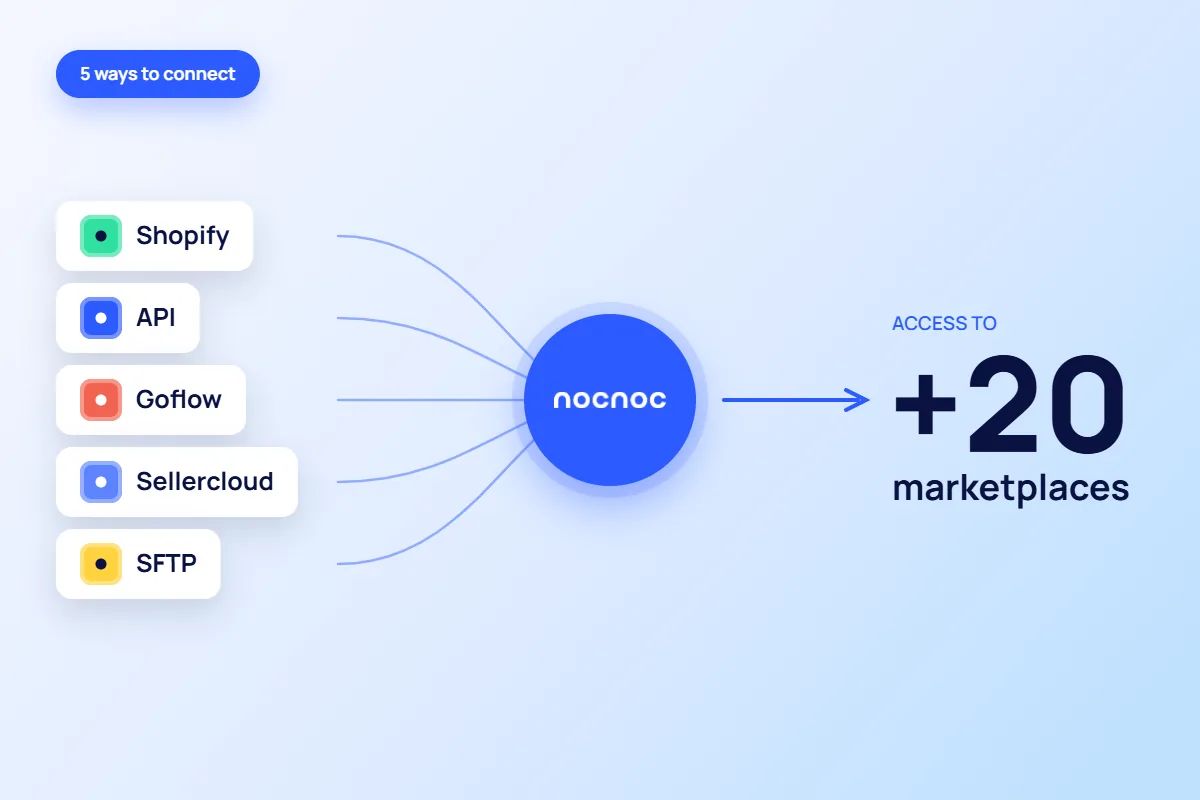
  • There are five ways to connect: Shopify, API, Goflow, Sellercloud, and SFTP — covering every type of tech stack, from no-code to fully custom.
  • Latin America is the fastest-growing retail e-commerce market in the world, set to surpass $335 billion by the end of the decade — and nocnoc lets you access it without building local operations from scratch.
  • nocnoc handles compliance, logistics, payments, and listing optimization so sellers can focus on growing their catalog.

nocnoc is a marketplace integrator built specifically for Latin America. One connection to your existing tech stack (Shopify, API, Goflow, Sellercloud, or SFTP) puts your catalog live on 20+ platforms across 7 countries, from Mercado Libre to Amazon Brazil to Walmart Mexico, while nocnoc handles customs clearance, listing localization in Spanish and Portuguese, and cross-border fulfillment.

Latin America is the fastest-growing retail e-commerce market in the world, and it will stay that way through 2028, according to EMARKETER. By the end of the decade, the region will be worth more than $335 billion in online sales, with more than 500 million consumers across Brazil, Mexico, Argentina, Colombia, Chile, and beyond. For U.S. sellers looking to sell internationally online, the question isn't whether the opportunity is there — it's how to connect to it without rebuilding your entire operation.

This guide covers each way to connect to nocnoc and which one fits your business.

What Is a Marketplace Integrator?

A marketplace integrator is a platform that connects your product catalog to multiple online marketplaces through a single integration. Instead of setting up a separate account and operation on each marketplace individually, you connect once and manage everything from one place: listings, inventory, orders, and shipping.

At its core, a marketplace integrator handles three things: centralized product listing management (same catalog, every channel, no manual re-entry), real-time inventory synchronization (no overselling, no stock discrepancies across channels), and automated order processing (orders from every marketplace flow into one system for fulfillment). Without one, each new marketplace means separate setup, separate processes, and separate management. It becomes unmanageable as you scale.

nocnoc does this specifically for Latin America. Platforms like Mercado Libre, Amazon Brazil, Magalu, and Coppel each have their own listing formats, categories, pricing rules, and compliance requirements. nocnoc handles all of that on your behalf, so you don't need to become an expert in each market to sell in Latin America.

Beyond the integration itself, nocnoc manages the full commercial layer: fulfillment from U.S. warehouses in Miami, New York, Los Angeles, and San Antonio; returns infrastructure across six LatAm countries; AI-powered listing optimization; and local account management in each market. Explore all nocnoc solutions →

5 Ways to Integrate with nocnoc

1. Shopify

If your catalog lives on Shopify, this is the fastest path to go live. You connect your Shopify store to nocnoc in a few minutes — no developers needed. nocnoc then imports your catalog and sets up the connection.

Once active, everything stays in sync automatically: stock levels, prices, orders, and tracking numbers. nocnoc orders from Mercado Libre, Walmart Mexico, or any other LatAm marketplace appear directly in your Shopify dashboard, just like any other channel. You can choose whether nocnoc uses your Shopify prices as-is, applies a percentage discount, or manages pricing independently.

New products can be easily imported to nocnoc — just let us know and it gets handled.

Best for: Sellers running their store on Shopify who want to add Latin America without changing their existing setup. → Full Shopify integration docs

2. API

The API integration is for sellers who want direct, programmatic control: custom tech stacks, ERP systems, or development teams managing their own operations.

Through nocnoc's API you can manage your full product catalog (including creating listings from existing Amazon ASINs, which saves significant onboarding time), sync inventory and pricing in real time, retrieve and manage orders, and handle shipping. Changes you make through the API propagate across all connected LatAm marketplaces automatically.

This is the most flexible option and gives you the deepest level of control over how your catalog interacts with nocnoc.

Best for: Sellers with a dev team or custom ERP who want full programmatic control. → Full API docs

3. Goflow

If you already use Goflow to manage your multichannel operations, you can connect nocnoc by adding it as a new store inside your Goflow account — the same way you'd add any other sales channel. The connection takes just a few minutes to set up.

nocnoc gets its own dedicated space in Goflow where you control which products to list, what prices to set for LatAm (independently from your other channels), and how much inventory to allocate. From there, orders, inventory levels, prices, and tracking numbers sync automatically in both directions. nocnoc orders arrive in Goflow for picking and shipping just like Amazon or Walmart orders do.

No separate system to learn. Your existing Goflow workflow handles everything.

Best for: Multichannel sellers using Goflow for fulfillment who want to add LatAm as a channel without changing how they operate. → Full Goflow integration docs

4. Sellercloud

Sellercloud connects to nocnoc through a file-based integration that runs automatically on a schedule. Credentials and templates are provided upfront; you configure the connection inside Sellercloud and it runs in the background from there.

The integration handles the full cycle: inventory and prices sync out automatically, incoming orders flow into Sellercloud for fulfillment, and tracking information goes back once orders ship. Setting up a separate company inside Sellercloud dedicated to nocnoc is recommended — it keeps LatAm orders and catalog separate from your other channels.

Best for: Sellers using Sellercloud as their central operations platform who want LatAm to work inside their existing setup. → Full Sellercloud integration docs

5. SFTP

SFTP is the option for sellers whose existing systems (ERP, WMS, or inventory platform) already generate and exchange data through scheduled file transfers. No API development required.

You upload inventory and tracking files to the server on a schedule; new orders and cancellations come back to you the same way. nocnoc runs the server and provides all credentials, so there's nothing to set up on your end.

Best for: Sellers whose existing systems support file-based data exchange and who want to avoid custom development. → Full SFTP integration docs

What You Get Access To

Every integration method unlocks the same marketplace network. nocnoc operates across 20+ platforms in 7 markets.

nocnoc — Marketplace Coverage
Marketplace Country
Mercado Libre Mexico, Brazil, Argentina, Colombia, Chile
Amazon Brazil, Mexico
Walmart Mexico
Coppel Mexico
Magalu Brazil
Americanas Brazil
Casas Bahia Brazil
Carrefour Brazil
Falabella Chile, Colombia, Argentina
Paris (Cencosud) Chile
Shopee Brazil

Plus Extra, Ponto Frio, Buscapé, Zoom, and Mobly in Brazil — and the network continues to grow.

How to Pick the Right Integration

It usually comes down to one question: what system do you already use to run your operations?

  • Running on Shopify? → The Shopify integration is often the fastest and simplest option.
  • Using Goflow? → You can connect nocnoc as another store while keeping your existing workflow.
  • Using Sellercloud? → Sellercloud is typically the best fit if you already manage your operations there.
  • Using a custom ERP or have a development team? → The API offers the most flexibility for custom workflows and deeper integrations.
  • Using another OMS, ERP, or WMS? → If your system can exchange files via SFTP, that's often a simple and reliable way to integrate — no custom development required.

If you're not sure which approach fits best, your nocnoc account manager will help you choose during onboarding.

Ready to Connect?

nocnoc supports every technical path a seller might come from: Shopify, API, Goflow, Sellercloud, or SFTP. But the integration is just the starting point.

Once you're connected, nocnoc handles the full commercial operation in Latin America on your behalf. That means listing localization in Spanish and Portuguese, dynamic pricing across each marketplace, customs clearance and import compliance in every country, and fulfillment from U.S. warehouses in Miami, New York, Los Angeles, and San Antonio. Returns, payments, and local account management in each market are covered too.

You focus on growing your catalog. nocnoc takes care of the rest.

Book a free exploratory call and we'll help you figure out which integration fits your setup and which markets fit your category.

FAQ

What is a marketplace integrator and how does nocnoc work as one?

A marketplace integrator connects your product catalog to multiple marketplaces through a single integration, managing listings, inventory, orders, and shipping from one place. nocnoc does this specifically for Latin America: one connection gives access to 20+ platforms including Mercado Libre, Amazon, Walmart Mexico, Magalu, and Casas Bahia, while handling compliance, logistics, localization, and payments across the region.

How long does it take to go live on LatAm marketplaces with nocnoc?

Most sellers go live within 48 hours of connecting. The Shopify integration is the fastest. API integrations depend on your development timeline. In all cases, nocnoc's team handles catalog localization, category mapping, and logistics setup — you don't have to figure those out on your own.

Can I use my existing Amazon catalog to sell in Latin America through nocnoc?

Yes. Through the API integration, sellers can create nocnoc listings by providing an Amazon ASIN. nocnoc pulls the product data from Amazon's catalog and populates the listing automatically, which significantly cuts onboarding time for sellers already established on Amazon.

What marketplaces does nocnoc connect to in Mexico and Brazil?

In Mexico: Mercado Libre, Amazon Mexico, Walmart Mexico, and Coppel. In Brazil: Mercado Libre Brazil, Amazon Brazil, Magalu, Americanas, Casas Bahia, Carrefour, Extra, Ponto Frio, Shopee, Buscapé, Zoom, and Mobly. The full network spans 20+ platforms across Mexico, Brazil, Argentina, Colombia, Chile, Uruguay, and Canada.

Do I need a legal entity in Latin America to sell through nocnoc?

No. nocnoc manages import compliance, customs clearance, and marketplace-specific regulatory requirements in each country on your behalf. You don't need to set up a local entity, hire local staff, or navigate LatAm regulations directly.

立即预订探索性电话!

无需任何商业承诺即可安排免费通话,我们将回答您关于在拉丁美洲商城销售的任何问题。

预约通话