Ecommerce Catalog Management for Latin America Without a Regional Team

Key Takeaways
- Latin America is home to more than 500 million consumers and online sales projected to surpass $335 billion, making it the fastest-growing retail ecommerce region in the world. Most U.S. brands are still figuring out how to enter it.
- For brands that want to sell on multiple marketplaces in the region, each listing needs to be adapted to dozens of different category structures, attribute requirements, and compliance rules, by country and by platform.
- nocnoc's ecommerce catalog management pipeline starts from a product code and handles enrichment, compliance screening, marketplace adaptation, prioritized publication, pricing, and campaigns. Sellers don't touch a listing.
- Products already in nocnoc's catalog skip directly into the buybox, competing for sales from day one on already-ranked, already-reviewed listings.
- On Mercado Libre alone, multiple sellers can list the same product, but the platform's algorithm surfaces the best-optimized listing first. Listing quality determines who gets the visibility, and who gets the sale.
Managing a product catalog across Latin America's 20+ major marketplaces means adapting every listing to different category structures, attribute requirements, compliance rules, and publishing specs, by platform and by country, without a local team. For most U.S. brands looking to start selling in Latin America, that's not something an existing team can absorb. nocnoc's answer: give us a product code, a stock level, a price, and a basic title and description. Everything else is handled end to end.
With more than 500 million consumers and online sales projected to surpass $335 billion, Latin America is the fastest-growing retail ecommerce region in the world. For U.S. brands figuring out how to sell internationally online, what's missing isn't ambition. It's the infrastructure to act without building a regional operation from scratch.
Global selling across Latin America requires exactly that infrastructure. nocnoc's seven-step catalog management pipeline was built specifically for this complexity: enrichment, compliance screening, marketplace-specific formatting, publication, pricing optimization, and campaigns, handled automatically from a single product code. Here's how it works.
The Four Problems U.S. Sellers Run Into Managing a Catalog in Latin America
Most U.S. sellers entering Latin America arrive with the same four questions. The answers are what shaped how nocnoc's catalog management pipeline was built.
How do I optimize my product listings to meet each Latin American marketplace's specific requirements?
Every major marketplace in the region runs a different category structure, attribute schema, and accepted values, and they don't map to each other or to U.S. platforms. nocnoc handles the adaptation automatically through a set of AI agents that rebuild each listing to the exact spec of every marketplace and country it publishes to.
Why aren't my products showing up in marketplace search results?
Search visibility on Latin American marketplaces is driven by listing completeness, category accuracy, and pricing competitiveness. A product with missing attributes, an incorrect category mapping, or a price outside the competitive range for its category gets deprioritized by the algorithm, regardless of how strong the product itself is. nocnoc's pipeline addresses all three variables before a listing goes live.
Do I need to fully rewrite my catalog for Latin America, or is a translation of my U.S. listings enough?
A translation is not enough. Latin American marketplaces use different category structures, different attribute schemas, and different accepted values than U.S. platforms. An Amazon US listing translated to Spanish and submitted to Mercado Libre will typically be rejected or miscategorized. Each listing needs to be rebuilt to match the specific data model of each platform and country, which is what nocnoc's adaptation step does automatically.
How do I manage, update, and sync a large catalog across many marketplaces and countries without doing it all manually?
Managing a large catalog across 20+ platforms in six countries isn't an operations challenge. It's an infrastructure one. The API management, inventory synchronization, and ongoing maintenance it requires go beyond what most sellers' existing teams can absorb. nocnoc's infrastructure handles it end to end, so sellers never interact with individual marketplace back-ends directly.
Why Ecommerce Catalog Management Is Harder in Latin America Than Anywhere Else
The complexity isn't obvious until you look at the specifics. Mercado Libre's category tree for electronics in Brazil doesn't map to Amazon Brazil's. Coppel's attribute schema for apparel in Mexico uses different field names, different accepted values, and different required fields than Magazine Luiza in Brazil. A product listing that publishes cleanly on one platform gets rejected on another because a required attribute the seller didn't know existed is missing. Across 20+ platforms and six countries, the failure rate on manual catalog publishing compounds fast.
The compliance layer adds another dimension. Electronics require specific certifications in Brazil. Health and cosmetics categories face additional documentation requirements in Mexico. A SKU that's approved for Mercado Libre Mexico may be restricted on Mercado Libre Argentina. Regulations on prohibited categories are not unified across the region. They vary by country, by platform, and sometimes by category.
Most U.S. brands entering Latin America don't know these rules. They shouldn't have to. nocnoc's pipeline handles them automatically, at every step.
nocnoc's 7-Step Ecommerce Catalog Management Pipeline
Step 1: Product Code to Full Listing (AI-Powered Data Enrichment)
nocnoc's catalog management starts from the minimum viable input: a universal product code (UPC, EAN, or ASIN), a stock level, a price, a title, and a basic description, nothing more is required from the seller.
From that input, nocnoc queries its internal catalog and external data sources to locate the product and enrich the listing to full completeness. AI-powered matchers identify and link the correct product record across sources. Product data enrichment then fills in missing attributes, technical specifications, dimensions, images, and secondary content. Everything that would otherwise require the seller to build attribute sheets, source product photos, and complete technical spec templates by hand.
The output of this step is a publication-ready, fully enriched product listing built automatically from a product code and a handful of basic fields.
Step 2: Already in the Catalog? Enter the Buybox Directly
If the product already exists in nocnoc's catalog (meaning another seller is already offering the same item), the new seller doesn't create a duplicate listing. The product enters nocnoc's internal buybox, competing directly against the existing offers for that item.
This matters because of how Latin America's major marketplaces work: multiple sellers can offer the exact same product, but the platform surfaces the best-optimized listing first, giving it more visibility, more impressions, and more sales. Mercado Libre alone handled 1.8 billion items through its logistics network in 2024, and across all of them, listing quality is the variable that determines who gets the sale. Entering an existing, already-ranked listing means inheriting its sales history and search position, instead of starting from zero and waiting months to build them.
Step 3: FastPass, nocnoc's Eligibility Engine
Before any listing goes live, it passes through FastPass, a proprietary eligibility engine developed by nocnoc that evaluates every product against every marketplace and country combination in nocnoc's network.
FastPass determines where a product is eligible to be published, based on category restrictions, local regulations, platform-specific requirements, and documentation status. It catches ineligible listings before publication is attempted: a product category that Coppel doesn't support, a SKU that requires Brazilian certification it hasn't received, a listing format that Walmart Mexico's API rejects.
The result: no failed submissions, no rejected listings, no sellers discovering mid-campaign that their SKUs are invisible on channels they were never going to qualify for. FastPass is how nocnoc maintains publication success rates at scale, by filtering invalid combinations before they cost time or API budget.
Step 4: Intelligent Marketplace Adaptation
As described above, each marketplace in the region runs a distinct data model, with its own category structure, attribute schema, and accepted values that differ by platform and by country. Building listings that match what each channel expects requires specialized knowledge most U.S. brands don't have in-house, and that's exactly what this step handles.
nocnoc addresses this with a set of specialized AI agents developed internally:
A categorization agent maps each product to the correct category on each marketplace, following that channel's own taxonomy rather than nocnoc's internal structure. An attributes agent populates every required and recommended field with the exact value each marketplace expects: the right units, accepted formats, and valid terms for that channel and country. For fashion and apparel categories, a variants and size table agent handles the conversion and formatting of sizing data to local market standards.
The same product gets transformed into correctly structured listings for Mercado Libre, Amazon Brazil, Walmart Mexico, Coppel, Magalu, and Falabella, each formatted to maximize that channel's publication success rate. Sellers don't need to know what any of these platforms require. nocnoc's agents handle it.
Step 5: Sale Probability Sequencing
nocnoc doesn't push an entire catalog live at once, or in the order products happened to arrive. Publication is sequenced using nocnoc's sale probability model (PMF), a proprietary scoring system that ranks products by their estimated likelihood of generating a sale on each marketplace and country combination.
The model factors in category-level demand signals, competitive pricing context, and product data quality to determine which SKUs have the best conditions for early success. Products with the highest estimated probability of selling in a given market are published first. Lower-probability items follow once the catalog's initial position is established.
For sellers, this means the catalog enters each market intelligently. Early publication slots go to the products most likely to generate revenue, building sales history and ranking signals that benefit the broader catalog as it scales.
Step 6: Infrastructure That Publishes at Scale and Stays Live
Managing marketplace integrations across 20+ marketplaces creates real infrastructure pressure: API rate limits per platform, data volume management, real-time inventory synchronization as stock changes, and ongoing listing maintenance as prices shift and marketplace requirements update.
nocnoc's publishing infrastructure handles all of it. API calls are prioritized and rate-managed within each marketplace's limits. The catalog doesn't just publish once. It remains live and accurate as stock levels change and pricing adjustments occur. When a marketplace updates its category requirements or introduces new mandatory attributes, nocnoc's system absorbs the change.
For distributors and brands with large SKU counts, whether hundreds or tens of thousands of products, this infrastructure layer is what makes multichannel selling across the region operationally viable.
Step 7: Price Optimization and Campaigns
A published listing and a selling listing are different things. nocnoc's final pipeline stage is designed to close that gap, consistently, across the full catalog.
Price optimization calculates the right price for each product on each marketplace: competitive enough to win the sale, structured to protect the seller's margin. Prices are evaluated against other sellers in the same category, adjusted for marketplace commission structures, and set within floor parameters the seller defines.
Beyond pricing, nocnoc manages advertising campaigns across platforms that support paid placement, including Mercado Libre and Amazon Brazil. Products that aren't gaining organic visibility get surfaced through sponsored placements. Products that are performing well organically get additional campaign investment to accelerate momentum. The objective for every SKU is not to appear on the marketplace. It's to sell on the marketplace.
What nocnoc's Catalog Optimization Actually Looks Like
Both listings below are for the same product, Rhode's Glazing Milk, sold by nocnoc on Mercado Libre. The first is the listing as it appeared with the seller's original input. The second is the same listing after nocnoc's optimization.
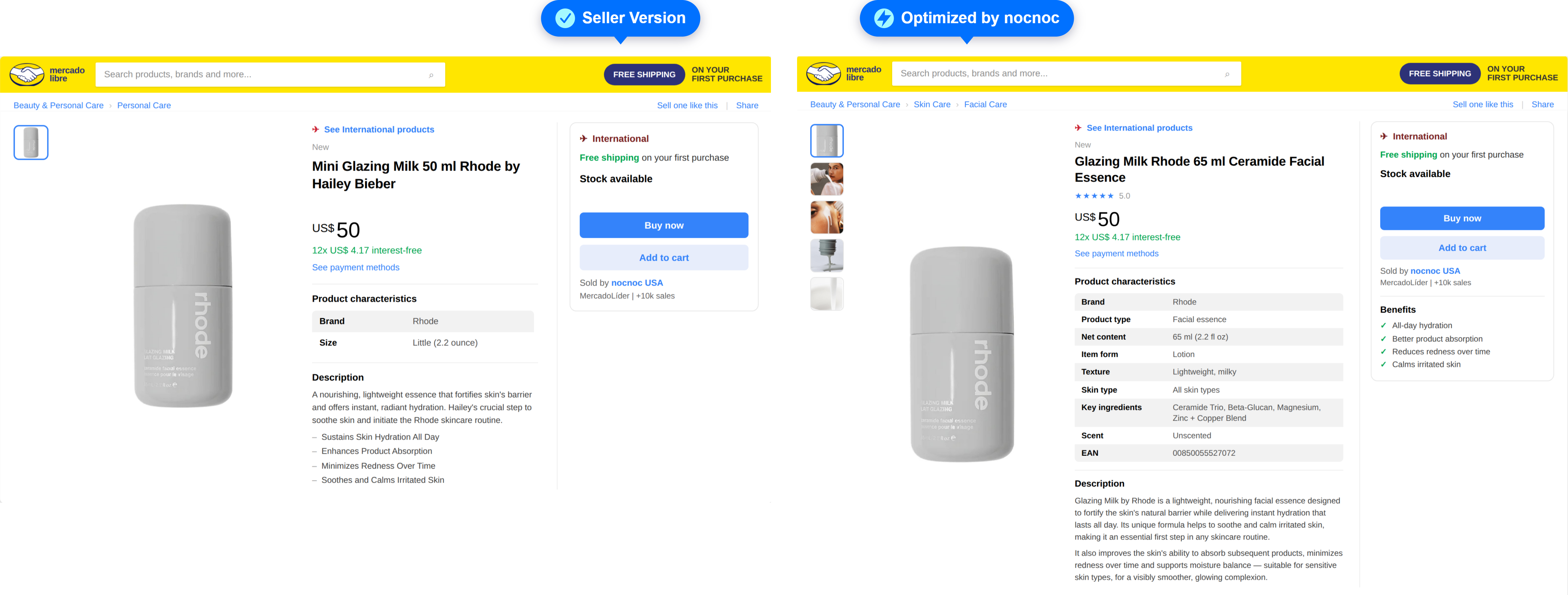
The differences are visible across every element that affects how a marketplace ranks and surfaces a product. The title went from a generic description to a search-optimized title that includes product type and key ingredient. The single product image became a gallery of five, including lifestyle and detail shots. The attributes table expanded from two fields (brand and size) to nine, adding product type, net content, item form, texture, skin type, key ingredients, scent, and EAN, which is what Mercado Libre's algorithm needs to correctly categorize and recommend the product. The category path deepened from Beauty & Personal Care > Personal Care to Beauty & Personal Care > Skin Care > Facial Care, placing it in front of a more targeted buyer. And the description was rewritten into structured, conversion-focused copy with a dedicated Benefits section in the buybox.
The seller provided a product code and a price. Everything visible in the second listing was built by nocnoc.
What Sellers Actually Need to Provide
The entire pipeline operates downstream from five fields:
Ready to Hand Off Your Catalog?
nocnoc is the full commercial layer between U.S. brands and Latin America's 20+ major marketplaces. Beyond catalog management, nocnoc handles cross-border logistics, local payment processing, customer service, and returns — across Mexico, Brazil, Argentina, Colombia, Chile, and Uruguay. No regional team, no local entity, no in-market operation required on your end.
Book a 30-minute discovery call. Tell us your product categories, your catalog size, and your target markets. nocnoc's catalog management services will show you which SKUs qualify for which marketplaces and what goes live in the first 48 hours. You don't need to know how Mercado Libre categorizes electronics, what Coppel requires for apparel, or which SKUs qualify in Brazil. We handle all of it.
FAQs
How do I know if my catalog is marketplace-ready before launching?
Before any product goes live, nocnoc screens every SKU against every marketplace and country it's being considered for. Products that don't meet a platform's category requirements, documentation standards, or local regulations are filtered before submission. Nothing publishes until it's confirmed eligible. No rejected listings and no invisible products after launch.
Is it worth optimizing my full catalog for Latin America, or should I focus on my top sellers first?
nocnoc's sale probability model answers this automatically. Before publishing, it scores every SKU by its estimated likelihood of generating a sale on each marketplace and country, based on category demand, competitive pricing, and listing quality. Highest-probability products publish first. Lower-probability SKUs follow once the catalog's initial position is established.
Why aren't my listings winning the buybox on Mercado Libre?
For brands that want to sell on Mercado Libre, the buybox surfaces the best-optimized listing for a product, not just the cheapest one. Winning it requires complete attributes, correct categorization, competitive pricing, and sufficient sales history. Products with incomplete data or incorrect categories get deprioritized regardless of price. nocnoc's optimization addresses all four variables before a listing goes live.
How do I know if my listing is actually optimized versus just translated?
A translated listing and an optimized listing are different things. Translation changes the language. Optimization means correct category mapping for that platform, complete attributes in the exact format the marketplace expects, search-relevant titles in local terms, and images that meet channel requirements. The difference shows up in impressions and sales, not just how the listing looks.
How much ongoing work does it take to keep a catalog updated across 20+ marketplaces?
Without dedicated infrastructure, it's significant. Stock levels, pricing, and marketplace requirements change constantly across platforms. nocnoc's system handles real-time inventory synchronization, pricing updates, and listing maintenance automatically. When a marketplace updates its category requirements or introduces new mandatory attributes, the infrastructure absorbs the change without the seller doing anything.