How to Sell on Amazon Mexico From the US in 2026
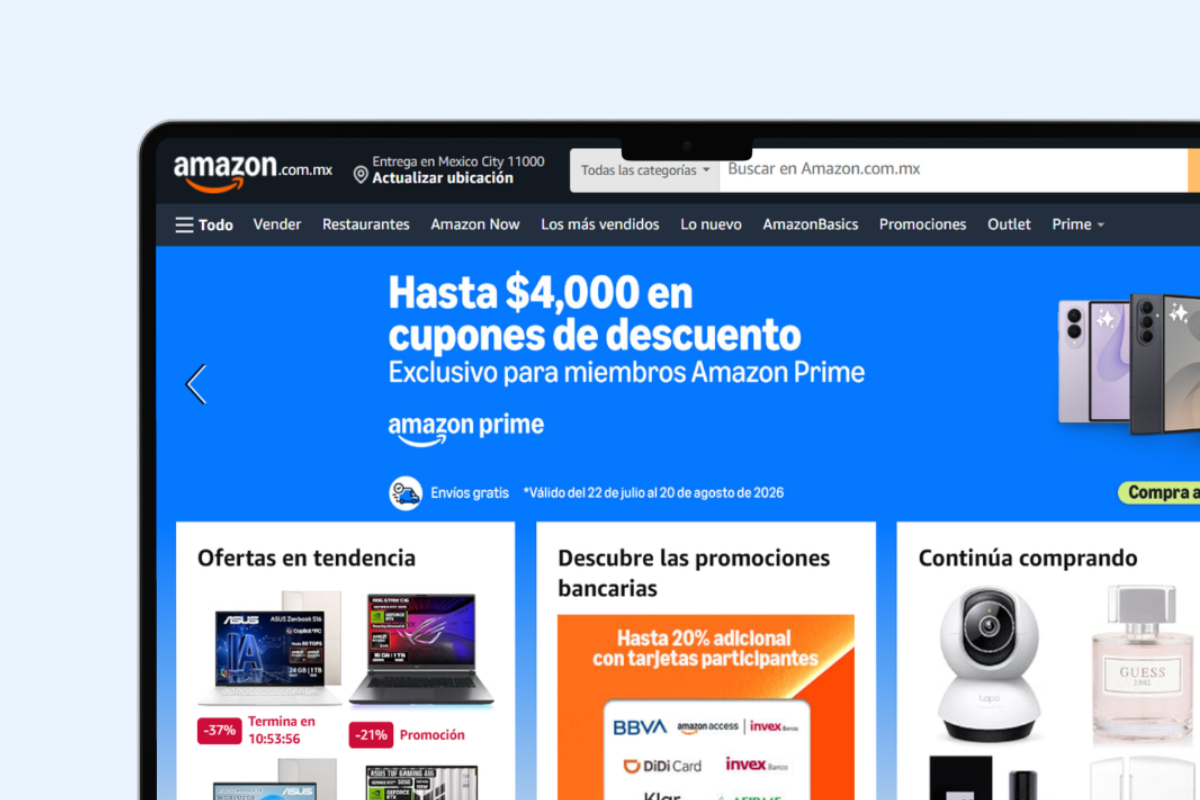
The fastest way to sell on Amazon Mexico from the US is through nocnoc. If you already sell on Amazon in the US, nocnoc can bring your existing catalog over using your Amazon ASINs and get you listed on Amazon.com.mx in under 48 hours, with no Mexican legal entity required. You can also manage an Amazon Mexico account directly yourself, which takes longer and puts localization, customs, and Spanish-language support on your own team.
Amazon.com.mx is the second-largest marketplace in Mexico after Mercado Libre, and it is one of the fastest-growing Amazon stores worldwide. This guide covers how to get set up, what it costs, the rules that apply to US-origin shipments, and how to optimize your listings once you are live.
Key insights
- Mexico's retail ecommerce market reached $55.3 billion in 2025, up 19.2% year over year, with 77.2 million online shoppers, according to AMVO.
- Amazon reports that 72% of Mexico's population bought online in 2024, with average spend per customer at $514.16, and expects 118+ million ecommerce users in the country by 2029.
- Only about 5% of US-based Amazon sellers sell on Amazon Mexico today, according to Marketplace Pulse, leaving far less international competition than on Amazon's larger marketplaces.
- Mexico's de minimis threshold for US-origin shipments is $117 (duty-free) under USMCA, well above the $50 general threshold and a real cost advantage over non-FTA sellers.
How Big Is the Amazon Mexico Opportunity in 2026?
Amazon Mexico is growing inside one of the fastest-growing ecommerce markets in the world. Mexico's online retail sales reached $55.3 billion in 2025, up 19.2% year over year, with 77.2 million online shoppers, according to AMVO, the country's ecommerce association. Ecommerce now makes up 17.7% of all Mexican retail sales, ranking Mexico eighth in the world by that measure.
Amazon's own global selling data shows 72% of Mexico's population bought online in 2024, spending an average of $514.16 per customer, and Amazon expects more than 118 million ecommerce users in Mexico by 2029.
International competition on Amazon Mexico is still thin. Only about 5% of US-based Amazon sellers sell on Amazon.com.mx, according to Marketplace Pulse (July 2024), and most of those rely on Remote Fulfillment with FBA rather than shipping inventory into the country. A more recent Marketplace Pulse analysis, from May 2026, found that active seller counts in Mexico have been falling even as web traffic keeps growing, similar to the pattern already seen in Brazil, meaning the sellers already there are splitting a bigger, still-growing pool of shoppers. Locally, Amazon Mexico's Country Manager, Renata Arvizu, told Mexico Business in June 2025 that the platform supports about 27,000 Mexican businesses offering more than 5 million products, with sellers averaging 93% sales growth in their first three years. Prime Day 2025 alone generated MX$1.64 billion in customer savings, with 93% of purchases made through the Amazon app.
How Do I Sell on Amazon Mexico From the US?
The easiest path is through nocnoc. If you already sell on Amazon in the US, nocnoc's API integration can create your Amazon Mexico listings directly from your existing Amazon ASINs, pulling your product data automatically instead of making you rebuild your catalog from scratch. It is one of five ways nocnoc connects to your existing tech stack: Shopify, API (including ASIN import), Goflow, Sellercloud, or SFTP, whichever matches how you already run your operation.
Once connected, nocnoc handles listing publication, pricing in Mexican pesos, customs clearance, and last-mile delivery, and can get your catalog live on Amazon.com.mx in under 48 hours, with no Mexican legal entity or tax ID required.
Bringing your catalog over is the easy part. What it does not do on its own is localize it: an Amazon US title, image set, and description pulled over as-is is not enough to rank or convert on Amazon.com.mx. That work is what the listing optimization section below covers.
If you would rather manage an Amazon Mexico account yourself, that direct path exists too. Amazon's own Remote Fulfillment with FBA works on the same principle nocnoc does: you ship inventory to your existing US fulfillment centers, and Amazon ships each order across the border to Mexico on demand, with no stock held inside the country. The difference is scope. Remote Fulfillment only covers Amazon Mexico and Amazon Brazil, while nocnoc applies that same on-demand, US-warehouse model across 20+ marketplaces, including Walmart Mexico, Coppel, and Mercado Libre, from a single integration. See the comparison further down for what managing it yourself involves.
What Are the Costs and Regulations to Sell on Amazon Mexico?
Selling on Amazon Mexico costs a monthly plan fee plus a referral fee per sale, and the tax you owe on each order depends on where the shipment comes from, not just what it is worth.
Plan and referral fees. The Professional selling plan is $39.99 per month and can cover the US, Canada, and Mexico together under one linked account. Referral fees are charged per sale and vary by category, so check Amazon Mexico's fee schedule before pricing your catalog.
Import taxes are based on origin, not just order value. Mexico processes cross-border orders under its Simplified Import Regime (T1). US-origin shipments pay 0% duty and 0% VAT up to $50, a 17% combined rate between $50 and $117, and 19% above $117. Shipments from China pay a flat 33.5% regardless of value, a real pricing advantage for US-based sellers on the same marketplace, according to nocnoc's guide to cross-border ecommerce logistics in Latin America. The regime caps orders at $2,500 FOB and 35 kg (77 lbs), with maximum dimensions of 78 x 78 x 125 cm.
Product compliance. Certain categories require extra documentation or are restricted outright, and getting this wrong is what holds packages at customs. Sellers going through nocnoc get their catalog screened for eligibility before anything goes live, so restricted items are flagged before they ever ship.
Legal entity and tax ID. You do not need a Mexican legal entity to sell on Amazon.com.mx. A Mexican tax ID (RFC) only becomes relevant if you store and sell inventory inside Mexico through full FBA. Selling through nocnoc, or through Amazon's own Remote Fulfillment program, ships from US-based inventory and does not require one.
How Can You Optimize Amazon Mexico Listings in 2026?
Optimizing an Amazon Mexico listing means adapting your title, keywords, images, and content to how Mexican shoppers actually search and buy, not translating your US listing word for word.
Write titles for local search behavior, not literal translation. Some Mexican shoppers search in English for international brands, others search entirely in Spanish. A title translated directly from English often misses the terms people actually type. Research the Spanish and English terms your category ranks for on Amazon.com.mx before finalizing titles and bullet points.
Fill in backend search terms deliberately. Amazon Mexico's search algorithm relies heavily on backend keywords, not just the visible title. Include regional spelling variants and local product names sellers commonly overlook when they only translate their US backend terms.
Localize images and A+ Content. Lifestyle images should reflect Mexican households and use cases, not reused US creative. Enrolling in Amazon Brand Registry unlocks A+ Content, which lets you add localized comparison charts, sizing guides, and lifestyle imagery directly on the listing.
Use Amazon's seller tools. Amazon Mexico now offers a generative AI tool that turns a basic product title or image into an optimized title, bullet points, and description, which Amazon says improves discoverability and cuts time to market. Combine it with Amazon Brand Analytics to see which search terms are actually driving clicks and conversion in Mexico.
Protect visibility with operational metrics. Reviews do not transfer between marketplaces, so every Mexico listing starts at zero regardless of your US track record. Price competitiveness, fulfillment method, and low cancellation rates all factor into who wins the Buy Box, so treat your first weeks on Amazon.com.mx like a new product launch, not an extension of an existing one.
Should You Sell on Amazon Mexico Directly or Through nocnoc?
Selling directly gives you full control and keeps more of each sale, provided your team can handle Spanish-language support, Mexican compliance, and ongoing listing localization. If you would rather test the market without building that operation first, nocnoc manages the entire process and gets your catalog live on Amazon Mexico, plus Walmart Mexico, Coppel, Mercado Libre, and other top marketplaces to sell in Latin America, from a single integration.
Start Selling on Amazon Mexico With nocnoc
If you want to test Amazon Mexico without building a local tax, translation, and support operation from scratch, nocnoc gets you live in under 48 hours. nocnoc manages listings, translations, customer support in Spanish, customs compliance, and last-mile delivery, so your team can focus on your catalog instead of the operational details.
nocnoc also connects you to Amazon Mexico's biggest local competitors, including Walmart Mexico and Coppel, plus 20+ other marketplaces across the region, through the same marketplace integration. If you are weighing Amazon Mexico against Walmart Mexico specifically, see our comparison of the two.
Sign up today and start selling on Amazon Mexico.
Frequently Asked Questions: Selling on Amazon Mexico
How do I sell on Amazon Mexico from the US?
The fastest way is through nocnoc: connect your existing Amazon catalog using your ASINs, or Shopify, Sellercloud, Goflow, or SFTP if that is your stack, and nocnoc lists, prices, and ships on Amazon.com.mx for you in under 48 hours, with no Mexican entity required. You can also manage an Amazon Mexico account yourself through Amazon's Unified Account or Remote Fulfillment programs, which puts localization, customs, and support on your own team.
What is the sales guide for selling in Mexico on Amazon?
Start by linking or creating a Professional seller account, choose a fulfillment method (Remote Fulfillment, full FBA in Mexico, or Fulfilled by Merchant), localize your listings for Mexican Spanish search behavior, and review Mexico's product compliance and de minimis rules before you price your catalog.
Do I need a business entity to become an Amazon seller in Mexico?
No. You can sell on Amazon.com.mx from the US without a Mexican legal entity, whether you go through nocnoc or manage the account yourself. A Mexican tax ID (RFC) only comes into play if you store and sell inventory inside Mexico through full FBA.
Can US cross-category brands sell on Amazon Mexico?
Yes. Amazon Mexico spans the same broad categories as Amazon.com, including electronics, beauty, home, and toys. Some categories require extra compliance documentation, which is why sellers going through nocnoc have their catalog screened for eligibility before anything goes live. Multi-category brands typically list across several categories at once rather than picking just one.
Is selling in Mexico worth it for a smaller brand?
For many smaller brands, yes. Mexico's de minimis threshold gives US-origin shipments a real cost advantage over non-FTA competitors, and Amazon reports its Mexican sellers average 93% sales growth in their first three years. The tradeoff is that reviews and reputation do not carry over from your US listings, so a smaller brand should expect to rebuild trust signals from scratch.
Does Amazon FBA work in Mexico?
Yes, in two forms. Remote Fulfillment with FBA ships Mexican orders from your existing US inventory with no local storage required. Full FBA in Mexico means exporting stock into Amazon's Mexican fulfillment centers for faster local delivery and Prime eligibility, which requires a Mexican tax ID (RFC). If you would rather not manage FBA logistics directly, nocnoc handles fulfillment and customs clearance on your behalf without requiring an RFC.