Top Online Marketplaces to Sell in Latin America in 2026
The best marketplaces to sell in Latin America in 2026 are Mercado Libre, Amazon, Walmart Mexico, Coppel, and Magalu, followed by strong local players like Carrefour, Americanas, Paris, Falabella, and Frávega. Together, these ten platforms cover the markets where US brands find the deepest cross-border demand: Mexico, Brazil, Argentina, and Chile.
No single platform dominates the region the way Amazon dominates the US, where it captures about 80% of marketplace sales. Latin America's marketplace landscape is fragmented by country and category, so a brand that relies on just one platform leaves demand on the table.
For US sellers, that fragmentation changes the playbook. Presence on only one marketplace means missing shoppers who split their attention across multiple leaders in every country. If Latin America is part of a broader plan to sell internationally, the right approach here is broad coverage of the top online marketplaces in the region, then expansion from that base to capture the widest share of demand.
Key insights
- Latin America is the fastest-growing retail ecommerce market in the world, and will stay that way through 2028, according to EMARKETER. By then, the region will be worth more than $335 billion in online sales, with more than 500 million consumers across Brazil, Mexico, Argentina, Colombia, Chile, and beyond.
- About 78% of ecommerce sales in Latin America happen inside marketplaces, so most demand is concentrated on these platforms rather than on standalone stores.
- Mercado Libre delivered $50.4B in GMV, 94M unique buyers, and 1.68B items sold across 18 countries in 2025.
- Latin American shoppers are mobile-first: about 84% of online purchases happen via smartphone
In this guide, we cover the marketplaces that matter most for global sellers expanding into Latin America, including both regional leaders and strong local players.
How Big Is the Ecommerce Market in Latin America?
By 2028, Latin America's ecommerce market will be worth more than $335 billion, with over 500 million consumers across Brazil, Mexico, Argentina, Colombia, Chile, and beyond, according to EMARKETER. That trajectory keeps the region on track as the fastest-growing retail ecommerce market in the world, a position EMARKETER expects it to hold through the end of the decade.
Where those sales happen matters just as much as the total. An estimated 78% of ecommerce sales in Latin America come from marketplaces, which is why these platforms capture the bulk of shopper demand across the region.
The marketplace landscape in Latin America is highly fragmented. Demand spreads across many platforms, and the mix changes country by country: some marketplaces operate regionally, while others are strong local players built around one specific market. Latin American shoppers are also mobile-first: about 84% of online purchases happen via smartphone, according to the same Endeavor and Mercado Libre report.
What Are the Best Marketplaces to Sell in Latin America in 2026?
The ten marketplaces below capture the largest share of cross-border demand for US brands expanding into Latin America in 2026, spanning Mexico, Brazil, Argentina, and Chile.
A strong global marketplace strategy is rarely built on one platform. The best results usually come from combining global giants with regional champions, increasingly managed through a single marketplace integrator instead of juggling separate seller accounts one by one.
1. Why Is Mercado Libre One of the Best Marketplaces to Sell in Latin America?
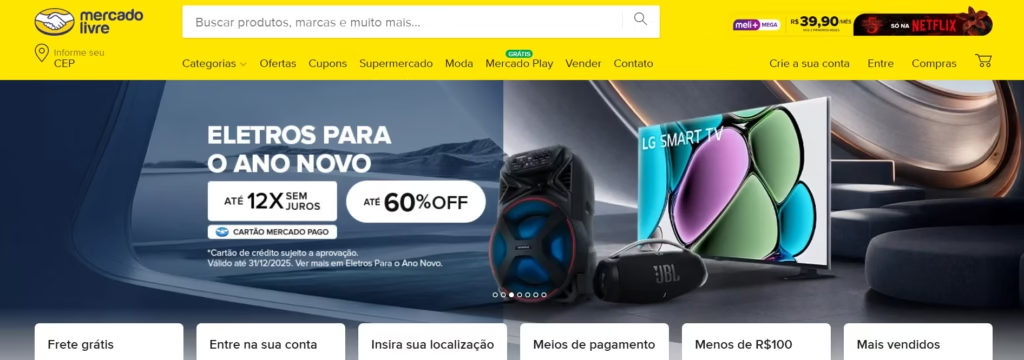
Mercado Libre is the leading marketplace in Latin America, operating across 18 countries with its biggest opportunities in Brazil, Mexico, and Argentina. In 2025, the platform delivered $19.1 billion in net revenue, $50.4 billion in GMV, 94 million unique buyers, and 1.68 billion items sold.
Mercado Libre offers far more than a storefront. Sellers can boost visibility through ads and promotional placements built for major retail moments, and payments run through Mercado Pago, which reduces checkout friction and expands payment access across the region. For US brands that want to operate directly rather than through a facilitator, Mercado Libre Global Selling explains how to list and ship without opening a local entity.
2. Why Should US Sellers Consider Amazon in Mexico and Brazil?

Founded in the US in 1994, Amazon is one of the world's largest marketplaces and a familiar entry point. In Latin America, its full marketplace operations concentrate in Mexico and Brazil, the two most relevant starting points for sellers targeting the region. Amazon.com's international shipping also reaches 15+ Latin American countries beyond those two.
For sellers, the appeal is execution. Amazon Mexico had over 30,000 sellers and more than 5 million products in 2025, and generated over 105 million visits in November 2025 alone. Amazon Brazil has over 80,000 sellers, more than 50 million products across 30 categories, and 214 million monthly visits. It is a channel built for speed, trust, and repeat purchase.
3. Is Walmart Mexico One of the Best Marketplaces to Sell Online in Mexico?
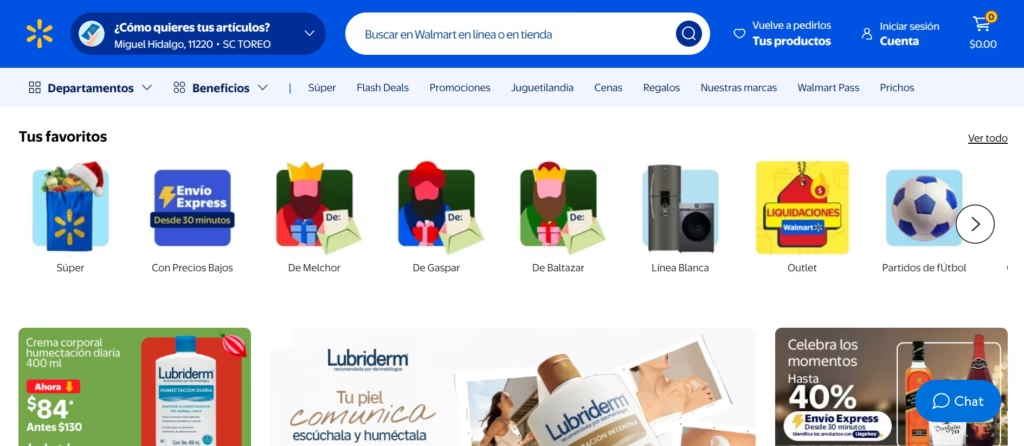
Walmart is one of the most recognized retail brands in the United States, known for its store network and broad assortment across essentials, home, and electronics. It opened its first Mexico store in 1991, and Walmart Mexico is today a major omnichannel player combining stores with online commerce across Bodega Aurrera, Sam's Club, Walmart Express, and Walmart Supercenter.
The Walmex marketplace generates over 80 million monthly visits and hosts more than 3,000 registered sellers, with strong demand in toys, electronics, and household goods. Streamlined cross-border processes and retail moments like HOT Sale and El Buen Fin can drive sharp sales spikes for international sellers. For a side-by-side breakdown, see how Walmart Mexico compares to Amazon Mexico on profitability for US sellers.
4. Why Is Coppel a Top Marketplace to Watch in Mexico?

Coppel is one of the best marketplaces to sell online in Mexico to watch in 2026. Founded in 1941, it built its reputation through a nationwide retail footprint and a value-focused assortment for price-conscious shoppers. Coppel's online marketplace spans over 2,000 product categories and draws more than 50 million monthly visitors.
Purchasing power drives Coppel's performance. The platform is closely tied to Crédito Coppel, its in-house credit line that lets customers buy now and pay in scheduled installments. More than 65% of transactions on Coppel.com use Crédito Coppel, a behavior that can lift conversion, especially on higher-ticket categories where installment payments reduce friction.
5. Why Does Magalu Matter for Selling in Brazil?

Magazine Luiza, better known as Magalu, is one of Brazil's most important retail brands. Founded in 1957, it scaled through a large physical footprint before moving early into digital commerce, including its first virtual store concept in 1992. Today Magalu operates exclusively in Brazil, connecting stores, marketplace sellers, and a mobile shopping experience central to how Brazilians discover and buy.
Magalu is a clear example of Brazil's mobile-first behavior: its apps reached 47 million monthly active users in 1H23. On Black Friday 2024, Magalu reported over $200.9 million in Friday-only sales, a 16% increase in customers, and the most downloaded app in Brazil that day. It is a serious channel for electronics, home, fashion, beauty, and toys.
6. What Makes Carrefour a Strong Marketplace Option in Brazil?
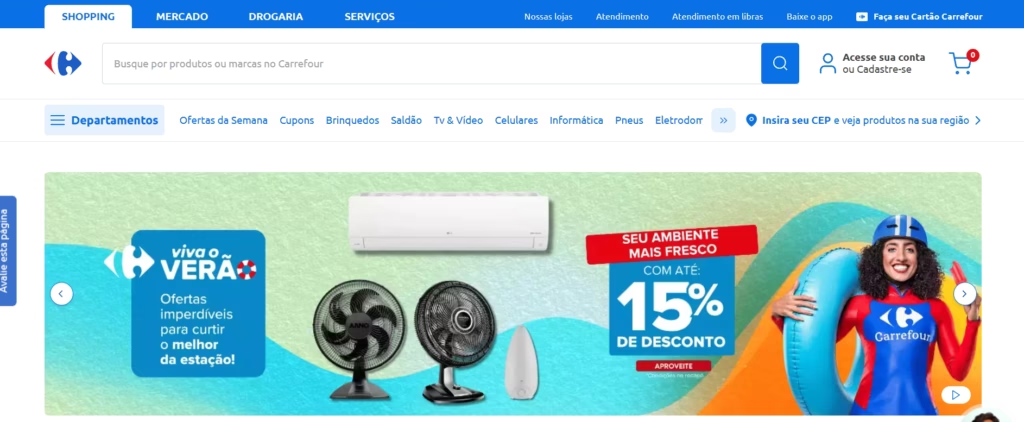
Carrefour is one of Brazil's best-known retail brands, and its marketplace is a relevant channel for sellers who want coverage beyond the usual players. The group expanded into ecommerce in 2016 and launched its third-party marketplace model in 2017, continuing to invest in its digital platform since.
Carrefour's marketplace receives over 20 million visits per month and performs especially well in electronics, home and decor, beauty, toys and games, and home appliances. The company posted $7 million in net profit in Q1 2025, up sharply year over year, supporting the case for continued traction in Brazil.
7. Why Is Americanas Still a Top Marketplace in Brazil?

Americanas is a long-running Brazilian retail brand that traces its roots back to 1929. Its online operation began with Americanas.com in 1999, an early mover in Brazil's digital retail evolution. Today Americanas ranks among Brazil's best marketplaces to sell online, with strong performance in electronics, home, toys and games, and beauty.
Americanas stands out for reach and distribution inside a crowded marketplace environment. In November 2025, Americanas and Magazine Luiza agreed to cross-list products across both platforms, a sign that major Brazilian players are teaming up to win shopper attention and share.
8. Why Is Paris Marketplace a Good Fit for Selling in Chile?
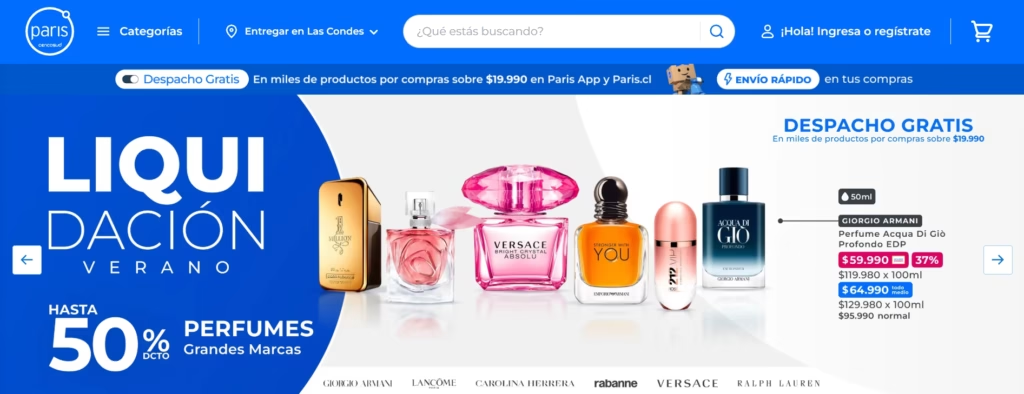
Paris Marketplace, operated by Cencosud, is one of the Latin America marketplaces to consider for selling in Chile, especially for coverage beyond the regional giants. As a long-established department store brand, Paris's online marketplace has turned paris.cl into a high-visibility ecommerce destination, with 10.68 million visits in October 2025 and 9.55 million visits in November 2025.
Paris Marketplace supports broad assortment and structured catalog management, organizing products into 92 product families across paris.cl and the Paris app. For brands, the opportunity is pairing local trust with marketplace scale in Chile.
9. How Does Falabella Enable Cross-Border Selling in Chile, Peru, and Colombia?
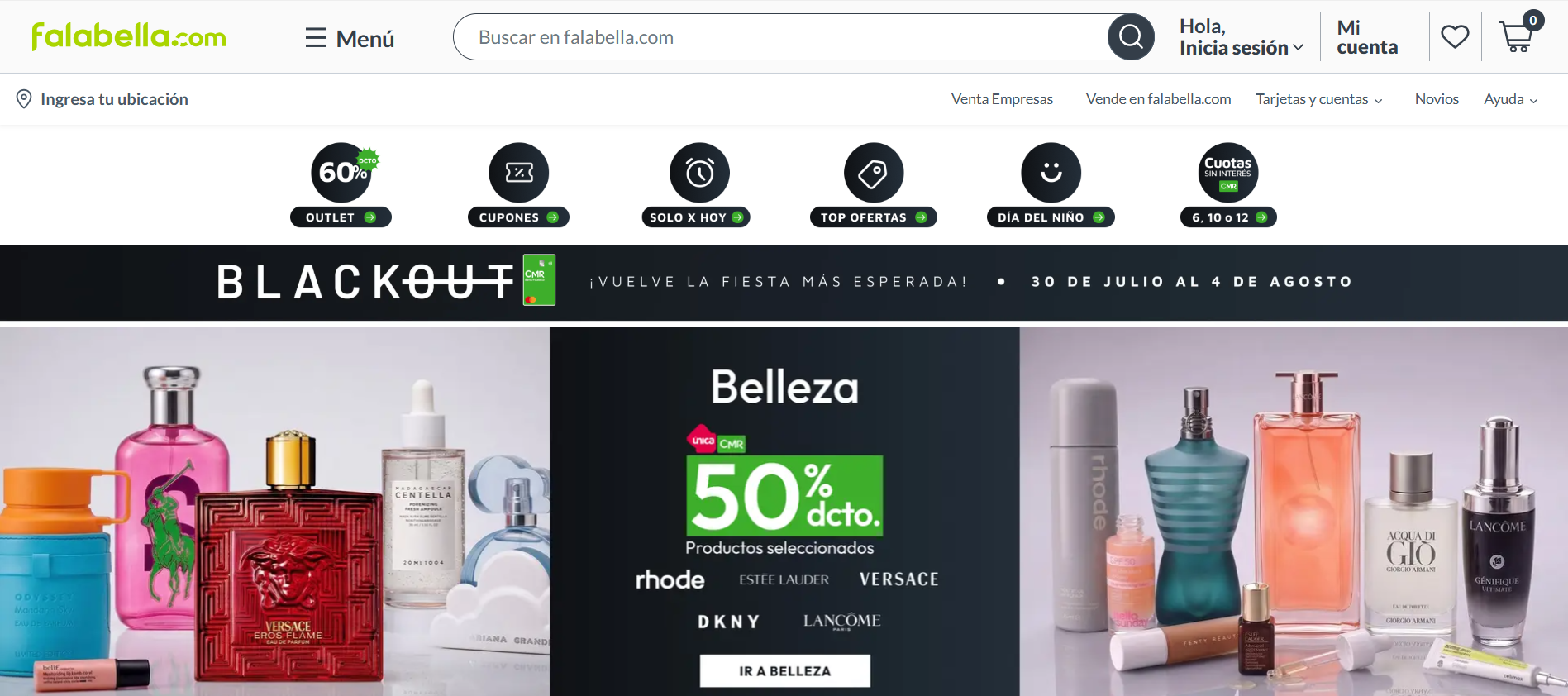
Falabella has built a serious ecommerce ecosystem in Latin America, and its marketplace is a strong option for US brands exploring cross-border ecommerce with regional reach. Through falabella.com and Linio by Falabella, it enables cross-border selling across Chile, Peru, Colombia, and Mexico under one regional strategy.
Falabella's model is seller-led. In Chile alone, the platform has more than 10,000 sellers, and in Q1 2025 its online GMV grew 17%, with 74% of that growth coming from third-party sellers.
10. Why Is Frávega One of Argentina's Top Marketplaces?
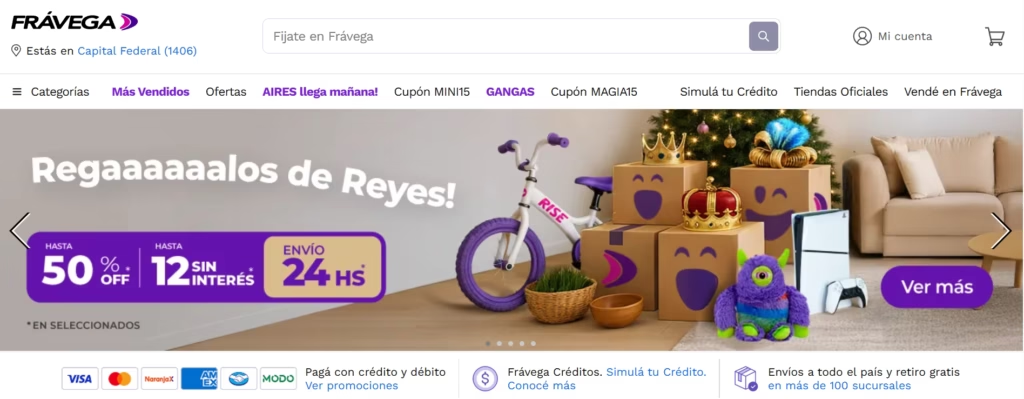
Frávega is one of Argentina's best-known electronics and home retail brands. Founded in 1910, it has grown into a major online shopping destination, combining strong local trust with meaningful digital reach. Fravega.com received 7.76 million visits in November 2025.
Beyond its own retail assortment, Frávega runs Frávega Market for third-party sellers, covering electronics, home, fashion, health and beauty, toys, and kids and baby. For sellers, the opportunity is local visibility in an Argentina-first marketplace environment.
How Can US Sellers Succeed on the Top Marketplaces in Latin America?
Choosing the right platforms is only the starting point. In Latin America, the sellers who scale are the ones who execute consistently across content, pricing, operations, and promotion.
- Listing localization: Translate and adapt titles, attributes, and descriptions into Spanish or Portuguese. Complete every required field for ranking and filters.
- Visual merchandising: Use clear, high-quality images that match local standards and show value fast for mobile-first shoppers.
- Offer competitiveness: Optimize total price, delivery promise, and return terms, often the biggest marketplace conversion drivers.
- Ads and promotions: Keep always-on ads for priority SKUs, and add deals and seasonal campaigns to capture demand spikes.
- Operational reliability: Protect seller metrics with stable inventory, fewer cancellations, and on-time delivery, since performance directly impacts visibility.
- Local customer experience: Offer support in the local language, with clear response times and policies to reduce friction and claims.
How Can You Start Selling Across Latin America's Top Marketplaces?
If you want to sell on the top online marketplaces in Latin America, nocnoc is the simplest place to start. With nocnoc, you can go live fast across six high-growth markets: Mexico, Brazil, Argentina, Colombia, Chile, and Uruguay. You can reach multiple marketplaces in under 48 hours.
nocnoc handles operations end to end, including shipping, cancellations, translations, listing optimization, and customer support. It also covers regulations, taxes, and marketing campaigns, so your team can focus on products and growth while nocnoc handles the heavy lifting in Latin America.
Want to kick off your 2026 growth plan now? Register today and start selling in Latin America.
Frequently Asked Questions: Selling in Latin America's Marketplaces
What are the best marketplaces to sell in Latin America?
The best marketplaces to sell in Latin America are Mercado Libre, Amazon, Walmart Mexico, Coppel, and Magalu, plus strong regional players like Falabella, Paris, and Frávega. Together they cover Mexico, Brazil, Argentina, and Chile, the markets with the deepest cross-border demand for US brands in 2026.
Which Latin America marketplaces should US sellers prioritize first in 2026?
Most US sellers should start with Mercado Libre, since it's the leading marketplace across Latin America and concentrates demand in multiple countries. But focusing only on Mercado Libre is a common mistake. The region is fragmented, and a meaningful share of shoppers buys on other major platforms depending on the country.
The smarter priority is a diversified mix: add the strongest country players alongside Mercado Libre, such as Walmart and Coppel in Mexico, Amazon plus Magalu in Brazil, Frávega in Argentina, and Paris and Falabella in Chile. This captures more demand and avoids leaving sales behind on the marketplaces that matter locally.
Do I need local inventory to sell internationally on marketplaces?
No, you don't necessarily need local inventory to sell internationally on marketplaces. Many sellers start cross-border by shipping from their home country or a regional hub, as long as they can meet delivery expectations, provide reliable tracking, and handle returns and customer support smoothly. The key is choosing marketplaces and logistics options that support cross-border selling.
What does "localization" mean for marketplace listings in Latin America?
In Latin America, localization means adapting your marketplace listings to match how people search, read, and buy in each country. It includes translating content into Spanish or Portuguese and adjusting titles, attributes, and terminology to local search behavior, not just running the same US listing through machine translation.
How do marketplace ads work in Latin America, and when should I start using them?
Marketplace ads in Latin America buy visibility inside each platform, mainly through sponsored product placements in search results and product pages, and sometimes banners or display ads. Start using them once your listings are localized, pricing and stock are stable, and you can meet delivery expectations, then begin with a small budget on hero SKUs and scale around key promo events. See the ultimate guide to advertising in marketplaces for a deeper walkthrough.
Do I need a separate seller account for each marketplace in Latin America?
If you sell on your own, yes: you typically need a separate seller account for each marketplace in Latin America. With nocnoc, a single integration lets you start selling across 20+ marketplaces in the region, connecting through Shopify, SellerCloud, GoFlow, SFTP, or nocnoc's Seller Center to manage listings, orders, and inventory from one place. Learn more about integrating with Shopify.